
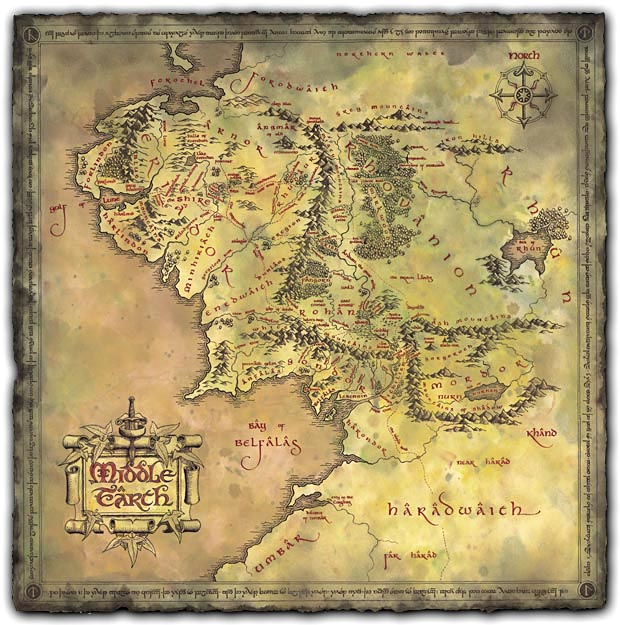
(While you may enjoy the following blog without a detailed knowledge of J.R.R. Tolkien, Middle-Earth, or the Lord of the Rings trilogy, I wouldn't suggest reading this unless you have either 1) read the books or 2) seen the Peter Jackson movies based on them. Much of what I write about here won't make sense unless you are somewhat familiar with the story. Also, just so you know, there are some plot spoilers.)
"The world is changing: I feel it in the water, I feel it in the earth, and I smell it in the air."
The words above appear, spoken by Treebeard, in the latter sections of Tolkien's novel The Return of the King. They could have just as easily appeared at the beginning of the first book in the Lord of the Rings trilogy, The Fellowship of the Ring, because the idea expressed in them is really one of the central themes of the entire work. Peter Jackson, the director of the recent LOTR films, apparently realized this; consequently, he includes the expression at the beginning of the first film as a kind of voice-over preface to the film trilogy. Granted, Galadriel (Cate Blanchett) speaks the words in the film as a way of segueing into the backstory about the One Ring's creation, but it works just as well when she says it as it does when Treebeard says it in the book. The point is that someone from the ancient world, as both Galdriel the Elf and Treebeard the Ent are, makes it clear to the younger folk (men, dwarves, hobbits) that times, well, they are achangin' . . . and not necessarily for the better.
True, by the end of the series, the powers of good have triumphed over the powers of evil. The Dark Lord Sauron has been defeated, the traitor Saruman is dead, a new benevolent King (Aragorn) has returned to rule over the land, and Frodo and the other Hobbits can return safely to the Shire. But at what price has victory been won? What evils have been wrought by the defeat of EVIL? This is plainly a major concern for Tolkien who could have chosen to end his story right after the Ring is destroyed and Aragorn is crowned King. Instead, the story lingers on the breaking of the fellowship, the scouring of more evil from the Shire itself, and Frodo's departure from Middle-Earth with the great Elven lords. Tolkien's point may be that victory in arms is never so simple that all opposition can be cleared away within a matter of a few days. The later plot points, wherein the evil comes home to the Hobbits in a way it never has before, resonate more fully precisely because Tolkien doesn't shy away from them. In other words, leaving out the scouring of the Shire or Frodo's sailing to Valinor might have made for more entertaining reading, but the story as a whole would have lacked honesty. The honest truth is that the restoration of order is a messy affair and takes time.
Aside from this, there is also the destruction of much that was good in Middle-Earth along with much that was evil. With Sauron's defeat comes the loss of many beautiful things, like the reign of the Elves or the Rings of Power themselves. Tolkien suggests that the passing away of another age (the Third Age, to be exact) brings with it a new time full of hope and optimism, but it also brings with it the death of many older values that were once held dear. For these reasons, we are told, the time of the Elves is over and the Age of Men has begun. Over time, especially after the Third Age, one can also see that not only will Elves lose prominence in Middle-Earth but also Ents, Dwarves, Wizards, and even Hobbits. Sure, the Orcs and Goblins won't be much of a bother in the future, but what the Elves? Where do they fit into the picture? Not in Middle-Earth apparently. In short, the world has been cleansed of a great evil, but it also loses great good in the process.
How does this happen? Does it make sense? Well, unfortunately it makes perfect sense. The One Ring's fate is bound up with the fates of the other ruling rings crafted by Sauron. If you can recall, there were three made for the Elves, seven for the Dwarves, and nine for the race of Men. Their survival depends upon maintaining the power of the One Ring; it can survive if they are each destroyed, but they cannot survive if the One Ring loses power. This, in effect, means that the Elves lose most of their power in Middle-Earth when their rings, which depend upon the One Ring's power, cease to function after the Ring falls into the fires of Mount Doom. Yet already, at the beginning of the books, we see the Elves leaving Middle-Earth in large numbers, abandoning it to pursue the Undying lands of Valinor. Even before the destruction of the One Ring, it seems that the Elves are becoming increasingly aware that their time in Middle-Earth is running out. A new age, for better or for worse, is dawning. The Ring's destruction just seals the deal. The Elves must leave Middle-Earth under the control of Men.
Of course, by the time Tolkien's story takes place, Middle-Earth has already seen plenty of change. Numerous stories, poems, and songs are sung or told throughout the narrative that express the nature of the past ages of Middle-Earth, with its various heroes, warriors, villains, and ladies fair. Each narrative makes clear by the teller of these tales (whether it be Gandalf, Bilbo, Aragorn, Treebeard or otherwise) that although good usually triumphs over evil, there is a high price to pay for such victory. The Old Ages, complete with their good and their evil, have passed from this world and have left room for new stories, new problems, new dilemmas, and maybe even new hope to enter the scene. So change is hardly an unknown idea in Tolkien's world. After all, Numenor decays and is replaced by the realms of Gondor and Arnor which, eventually, also decay. All things pass away, and nothing remains. What's remarkable about the changes in Middle-Earth that we witness in the Lord of the Rings trilogy is that they are steadfast and binding. These changes cannot be undone.
After every age, in real life or in fiction, new times succeed the former. Sometimes we mistakenly believe that the past was only full of innocent, good times, but any accurate history book would tell us that this was simply not the case. The past was full of its fair share of atrocities and evil. Still, it seems to be true that as time goes by everything either alters or ceases to be. That's true of the good as well as the bad. So, while it may be true to say that much of what was great about the past is now gone, it's also accurate to say that much of what made the world a scary place has now ceased. Does this mean our own age is a better time? Or maybe we are worse off than our ancestors? Change suggests neither possibility. What change does express is that we have our own unique set of problems, dilemmas, and moral questions in this age and in any other. There is much that is good and beautiful about our world, and there is also much that is frightening and even evil. What's sad is that all the good cannot survive without all the bad. This is the nature of our world and Middle-Earth too: times change both for better and for worse.

You have the best blog on the interwebz! I enjoyed this one immensely, and I will have to make sure Andrea reads it. It's become my goal in life to convert her to Tolkien's dark side. Muahaha! Well done, Mr. S!!!
ReplyDeletep.s. I guess it's worth mentioning that Clem P. is short for Clementine (from Eternal Sunshine) Prufrock (from "Prufrock" obviously ;p). Autumn thought that one up.
Great Blog! People often go forth in the name of change thinking that everything that they saw as wrong is automatically fixed and what they see is good is automatically accepted into the fold. This is often not the case. Change is just that. It is a word. A word not associated with the theme good or bad. It has a definition of course, but as far as interpretation that is up to the person or world that is achangin' sometimes we need to bid adieu to some of the good and accept some of the bad as a way to grow and to learn. Like in LOTR the shire is different because of all the things you mentioned, but also because of the journey that members of their society took. Tales told orally around the wood bring forth a sense of awareness that lacked before. So, i guess change and awareness coincide... very good stuff...very good stuff indeed...thanks for ginving me something to ponder..
ReplyDelete