
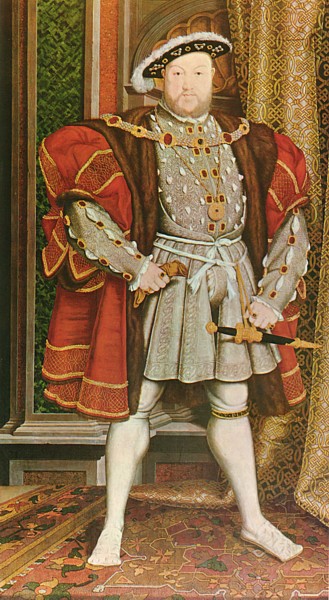
Once upon a time (for this is how all love stories should begin), there was a ruthless, lecherous king of England married to a beautiful but somewhat somber Spanish beauty named Catherine of Aragon. This certain king desired nothing more than to produce an heir to his throne with the help of his wife, but this simple duty turned out to be more trouble than he had realized. Catherine had unfortunately experienced a number of stillbirths and miscarriages; her only living child was a girl she had, being Catholic, named Mary. Her husband, the king, was most displeased with the results of his efforts to have a child with his Spanish wife, and so he resolved to cast her aside and marry a vixenish young girl ho had caught his majestic eye, one Anne Boleyn. Perhaps, thought the king, she would be able to produce an heir.
I'm sure if you know anything at all about history, then you've guessed by now that the king in question is, of course, Henry VIII. My description of his abandonment of his first wife, however, is grossly oversimplified and perhaps a little unfair to Henry, so let me be more generous with information. I know we are all familiar with how Henry had six wives, how he divorced some and beheaded others, how his surviving children fought and bickered and argued for the throne, and how various religious forces (both Catholic and Protestant) used these monarchs to advance their own sometimes crooked agendas. Still, let me enlighten you on a few details you might not know. I may be able to present a more sympathetic view of poor Henry than you ever thought possible.
First, Henry had quite a precedent to live up to, that precedent being his older brother Arthur. Yes, Henry was born the second son to his mother and father which means, if all had gone as planned, Arthur would have been king and not Henry. As Arthur reached maturity, his parents betrothed him to the a young Spanish noblewoman in hopes of creating a strong alliance with Spain, at that time the most powerful nation in Europe. This young noblewoman was, you guessed it, Catherine of Aragon. Interestingly enough, Catherine was the daughter of the famous couple Ferdinand and Isabella. You know, the folks who financed Colombus' journey to the New World? Well, young Catherine was brought to England, she lived in residence with the royal family, and married the would-be-future king. Arthur, unfortunately, died soon after from either consumption, complications of diabetes, or the sweating sickness. Arthur's parents, not wanting to lose the relationship with Spain they had fought for so long to achieve, quickly conspired to wed the Spanish princess to their next son Henry.
After Henry was proclaimed Prince of Wales and Catherine became his wife, the two settled down to the business of preparing to become England's monarchs. Part of their responsibilities as monarchs entailed that they produce a male heir to the throne, an obligation they, and the rest of the country, took very seriously. Yet, after a time, Henry and Catherine both realized that a male heir would perhaps be impossible. Both times Catherine had given birth to a male child, the child had died very soon thereafter. Henry began to suspect that his marriage was somehow cursed. Then one day, while studying the Bible, Henry came across a passage in the book of Leviticus, chapter 20 and verse 21 where it states: "And if a man shall take his brother's wife, it is an unclean thing: he hath uncovered his brother's nakedness; they shall be childless" (KJV). Henry, being heavily schooled in theology as part of his princely education, interpreted this passage to mean that his marriage was indeed cursed because he had married his brother's wife. He believed that as long as they were married, he would be without an heir.
Now, two things can be said of Henry's superstition. One, it makes his decision to divorce Catherine seem a little more understandable. If he were indeed tormented by the thought of committing incest ( which he thought he was doing), then it stands to reason that he would want to make a clean break of things both for his own sake and for Catherine's. Still, his argument didn't really hold up in some pretty obvious ways. After all, he and Catherine were NOT childless. Their daughter Mary was proof of that. Also, another passage in the Old Testament, this time from Deuteronomy 25:5-10, encourages a man to marry his brother's childless widow and father children with her so that she does not remain childless. In the Old Testament days, this was a way of ensuring that young widows weren't left out in the cold without familial support and protection. Fittingly, Catherine envoked this passage of scripture in her defense of her marriage to Henry. She also claimed that her marriage to Henry's brother Arthur had remained unconsummated, meaning they had never made it official by having sex. There was no method to prove the matter, however, but historians have speculated in various ways since Catherine's claim.
Also, whether or not Arthur and Catherine consummated their marriage, it is a certainty that Henry had already abandoned his wife's bed for the love of another woman, the aforementioned Anne Boleyn. I won't say much about Miss Boleyn since she isn't really the focus of the piece, but briefly I'll give you an idea of how Henry became infatuated with her. She was known to be quite beautiful, somewhat flirtatious, witty, charming, and gracious. Henry had already courted her sister and probably slept with her too (yikes!) before changing course and instead courting Anne. By the time he began to seek a divorce, he felt sure he was in love with her. Divorcing Catherine would allow him to court Anne officially as well as secure him the opportunity of marrying her and beginning the process of producing a male heir all over again. Naturally, many scholars and historians speculate that Henry's attraction to Anne Boleyn may have been the real reason Henry wanted a divorce. This theory believes that the Leviticus passage was just a ruse to make the whole affair seem more legitimate in the eyes of the Pope, who was the only person in all of Christendom would could grant a church-sanctioned divorce at this time. Remember, almost everyone who was Christian was also Roman Catholic, but there will be more on this later.
Now Catherine's claim about her marriage to Arthur remaining unconsummated is perhaps one of the pivotal moments of Christian history. Why, you may ask, was a private marital matter between a husband and a wife so important in the development of Christianity later on? Well, the answer to this is too long and complicated to explain here. See the second part of this blog for more information!
